
GeminiClaw: Local-First Multi-Agent Orchestrator
Enough chat assistants. GeminiClaw is a multi-agent AI platform with autonomous execution, guardrails and real governance.

Fabiano Brito
CEO & Founder

GeminiClaw is a local-first multi-agent runtime designed to execute real operations with traceability, security, and configurable autonomy. For enterprises, it provides the loop guards, isolated memory, and audit trails necessary to safely run AI agents in production without constant supervision.
Most "AI agents" you see out there are, in practice, glorified chatbots: they receive a message, call an LLM, and return text. GeminiClaw was built to do the opposite — execute real operations, with traceability, security and configurable autonomy.
Why build yet another agent framework?
The question is legitimate. There are dozens of frameworks — LangChain, LlamaIndex, CrewAI, AutoGen. The short answer: none was good enough to operate in production without constant supervision.
The recurring problems we identified in real projects:
What breaks in production
- No Loop Guard — infinite loops
- Excess permissions through inheritance
- Memory without boundaries between sessions
- Zero audit surface post-incident
What was designed in
- Loop Guard + configurable autonomy
- Intent-aware tool subsets per agent
- Memory isolated by
agentId+chatId - Unified timeline of tool calls
GeminiClaw was built on Building Applications with AI Agents (Michael Albada, O'Reilly) — one of the most technically sound sources on agent engineering — and then adapted to the operational needs we encountered in the field.
The architecture in terms that matter for operations
The conceptual model has a distinction that rarely appears in other frameworks:
| Concept | What it is in GeminiClaw |
|---|---|
| Platform | The complete product: Studio, runtime, channels, governance. |
| Runtime | Execution layer — loops, approvals, replay and tool routing. |
| Agent | Cognitive/operational entity with isolated memory and tools. |
| Skill | First-class capability package: metadata, dependencies, policy. |
| Tool | Executable capability with explicit contract — the real execution primitive. |
| Channel | Delivery surface: Telegram, CLI, WhatsApp. |
| Control Plane | Administrative and observability surface. |
This separation is not academic — it determines how you expand the system without creating accidental coupling. Channel is not agent. Skill is not tool. MCP is not agent. These confusions create fragile systems.
What GeminiClaw does differently in practice
1. Multi-agent orchestration with clear ownership
A main orchestrator + specialized subordinates. The Request Ownership rule is explicit in the runtime: every task stays with the agent to whom the user addressed it. Handoffs work for scoped delegation — not silent reassignment. Avoids the confusion of "who is responding now?".
Each agent has: intent-aware tool subsets (quick_answer, read_only, execute, plan_first), isolation by agentId + chatId, and long-term semantic memory via gemini-embedding-2-preview — a multimodal model unifying text, images, audio and documents in a vector space.
2. Autonomous execution with safety gates
This is the point where most frameworks stop. GeminiClaw has multi-layer autonomy control:
present_code_plan) — no code mutation occurs without an approved plan.The agent is not autonomous because it has no limits. It is autonomous because the limits are well-defined — and it operates with confidence within them.
3. Real Google Ads B2B operations
One of the most concrete verticals: full Google Ads automation via API. This is not "generating ad text" — it is real operation:
- Campaign diagnosis and mutation via Google Ads API
- Batch optimization workflows (
optimize_campaign_batch) - Dayparting, budgets, RSA optimization, negatives, geo targeting
- Demographic guardrail automation (
apply_demographic_guard) - Offline conversions + lead quality pipeline
4. GeminiClaw Studio — the dashboard that was missing
The entire runtime is operated via GeminiClaw Studio, an operator-oriented (not developer-oriented) web dashboard.
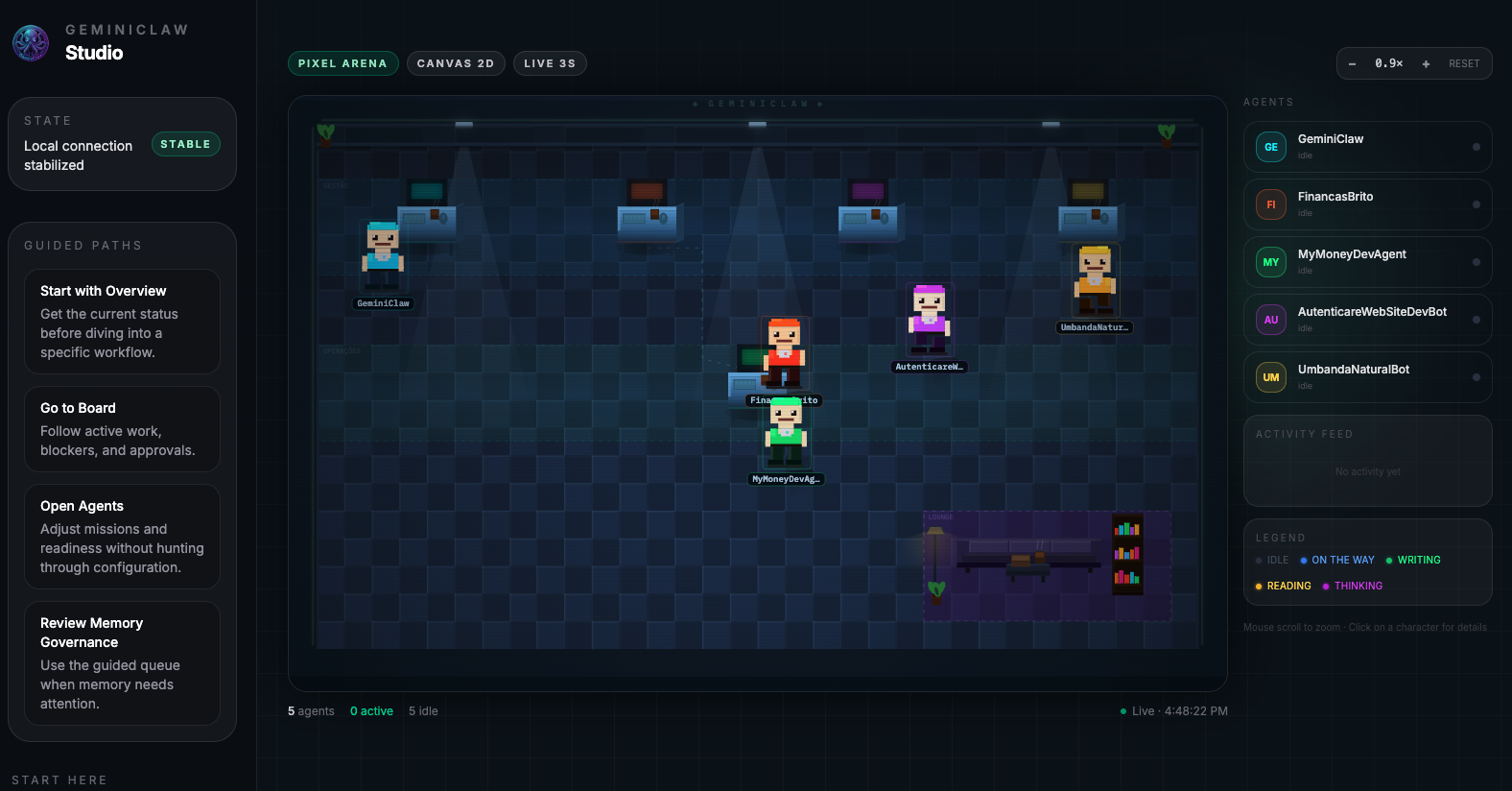
Pixel Arena: each agent appears as a character on the map, with state and context visible in real time. "STABLE" state + Guided Paths in the side panel.
The main surfaces:
- Board — Operational Kanban for tasks and real-time monitoring.
- Unified Timeline — task audit, tool call history, message traces.
- Memory Governance — inspection, expiration, redaction and purge of memories, with audit trail.
- Session Contexts — creation and activation of contexts that change memory boundaries in work mode.
- Scheduler Center — monitoring of scheduled routines.
- Governance Inbox — recommendations grouped by urgency, with direct actions.
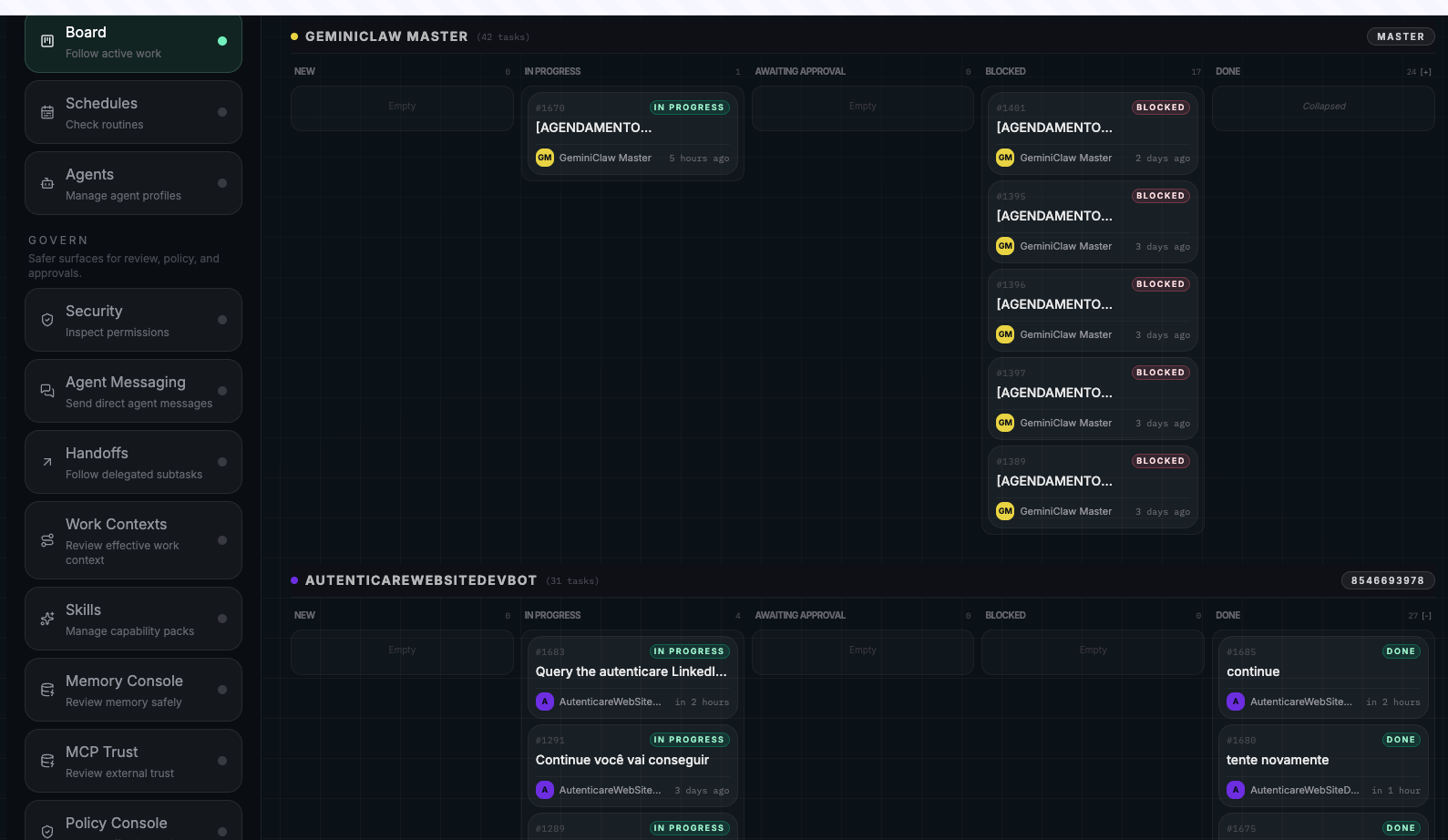
GeminiClaw Master Board: 42 tasks across New, In Progress, Awaiting Approval, Blocked and Done — with timestamps and full traceability.
5. Context control via Telegram
Native Telegram commands for field operation — without opening Studio:
/session— displays the active work context/session_set <sessionId>— activates a specific session/session_complete— marks session as completed and generates a durable recap/session_suggest <message>— suggests which session best matches the current intent
Real risks and where GeminiClaw still has friction
Connection with Autenticare's A-MAD methodology
GeminiClaw is not a side project — it is the practical implementation of the A-MAD methodology (AI-Managed Agile Development) that Autenticare uses in client projects. When we talk about "agents that orchestrate the heavy structure while engineers focus on the 20% competitive differentiator", GeminiClaw is the runtime that makes it possible.
In real projects:
- Google Ads operations automation for B2B clients with significant budgets
- Work context management in long assisted development sessions
- Lead-to-conversion pipelines with automated quality feedback
Frequently Asked Questions sobre GeminiClaw: Local-First Multi-Agent Orchestrator
What is GeminiClaw? GeminiClaw is a local-first multi-agent runtime with Planning Gate, Risk Gate, Loop Guard, checkpoint/replay, and audit trail. It is a practical implementation of the A-MAD methodology.
Why was GeminiClaw created? GeminiClaw was built because existing agent frameworks were not good enough to operate in production without constant supervision.
What are the main components of the GeminiClaw architecture? The main components include Platform, Runtime, Agent, Skill, Tool, Channel, and Control Plane.
How does GeminiClaw handle multi-agent orchestration? GeminiClaw utilizes a core orchestrator with specialized subordinate agents, maintaining the Request Ownership rule explicit in the runtime.
Want to see governance + real execution in an agent runtime?
Official site at geminiclaw.dev. Simple prerequisites: Node 20+, Telegram token, Gemini key. Initialization: npm run watchdog. Autenticare implements enterprise agent stacks at this level of operational maturity.